Freezer Repair
Frost Around a Sub-Zero Freezer Drawer Through a Denver Winter
- Written by
- Tobias Reinhardt
- Role
- Refrigeration technician — doors, gaskets and cabinet fit
- In the trade
- 9 years in the trade
- Certified
- EPA Section 608 certified
Frost inside a built-in freezer is information, and most of it is in the location. Before deciding what has failed, work out where the ice actually is: around the drawer opening, on the back wall of the compartment, or across the food itself. Each of those points somewhere different, and two of the three are cheap.
This is one of the most common winter calls on this route, and Denver’s air is the reason. The moisture that becomes frost is not coming in from outside — it comes from your kitchen, in the couple of seconds a drawer is open. What the local climate changes is how well the cabinet keeps that air out afterwards.
A rim of ice around the opening: sealing
Frost that forms in a band around the drawer front, on the flange it closes against, or along one edge of a freezer door, is warm air arriving continuously rather than occasionally. There are only three ways that happens.
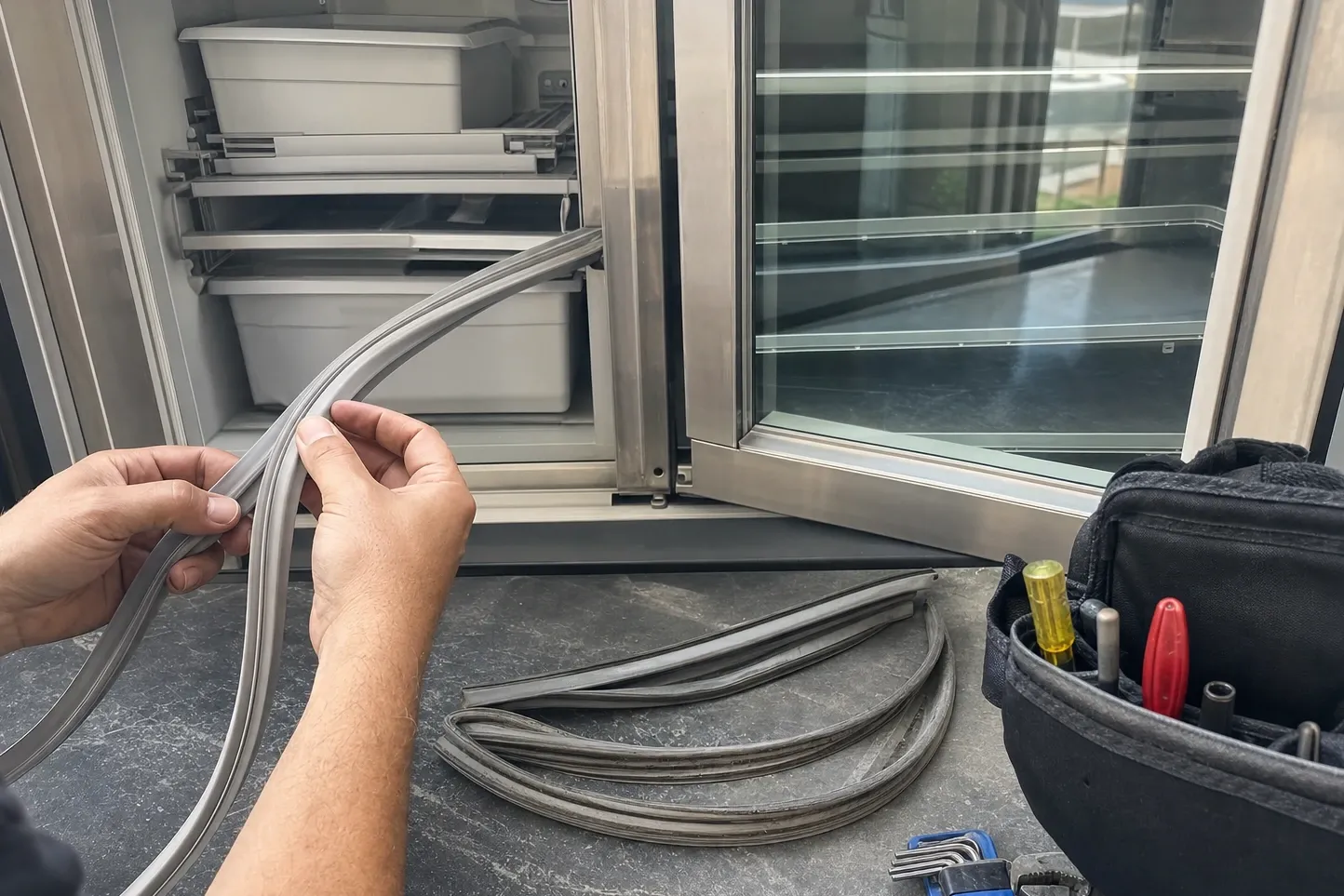
The gasket has hardened. Sub-Zero door and drawer seals are a compound that stays flexible in humid air and goes stiff in air that spends months in single figures. Denver does exactly that. A hard gasket does not tear or look damaged — it simply stops taking the shape of the cabinet flange, and the magnet inside it is not strong enough to pull a stiffened seal home. Run a hand along it: it should feel like a soft, slightly tacky rubber and dent under a fingertip. If it feels like a garden hose, it is finished.
The drawer is out of alignment. Freezer drawers on built-ins run on slides that sag over years of loaded weight. A drawer that no longer closes flush leaves a wedge-shaped gap at one corner, which is where the frost concentrates. Look at the gap along the top edge with the drawer shut, from one side to the other. It should be even.
Something is holding it open. A bag of peas an inch behind the front panel is the most-diagnosed fault in refrigeration.
A sheet of ice on the back wall: defrost
Frost that builds as a flat white sheet across the rear panel, or that packs solid behind it, is a defrost problem. This one is worth understanding, because it is the fault most often misdiagnosed as a dying compressor.
A freezer evaporator collects frost constantly — that is normal and by design. Several times a day, a heater warms the coil, melts the frost, and the water runs out through a drain tube to a pan where it evaporates. If the heater fails, or the sensor telling the control board when to run the cycle drifts, that melt never happens. The coil ices over solid, air stops passing through it, and the compartment starts warming even though the compressor is running normally and the coil itself is freezing cold.
The tell is the combination: a compressor that sounds fine, a compartment in the teens instead of near zero, and a rear wall that is either frosted over or suspiciously cold to the touch. Food drying out and shrinking in the bin belongs to the same story — with no air movement, ice sublimes straight off the surface of whatever is in there.
The drain, which brings the fault back
There is a second-order version of the defrost fault worth knowing about, because it is why an ice problem sometimes returns a month after being fixed.
If the drain tube ices up at its outlet, the defrost cycle still runs, the frost still melts, and the water still has nowhere to go. It refreezes in the trough, builds back up into the evaporator, and you are exactly where you started. A technician who clears the ice and replaces the heater without following the drain to where it empties has done half the job. On integrated units in tight cabinetry, that outlet is often the hardest part of the machine to reach, which is precisely why it gets skipped.
What to check before booking anything
Fifteen minutes, no tools:
- Photograph the frost. Where it is beats any description over the phone, and it saves a diagnosis being made twice.
- Empty the drawer and look at the closing edge with a torch. Even gap all the way along, or wedged at one end?
- Press the gasket at the corners and along the front. Soft and slightly tacky is right; hard and shiny is a replacement.
- Put a thermometer in the middle of the compartment for a few hours. Near zero is right; the teens is a fault; above 20°F is urgent.
- Listen at the back wall. A soft flow of air is the circulation fan working. Silence with a cold cabinet is the classic iced-evaporator signature.
If it turns out to be a bag of peas or a drawer someone has been overfilling, that is a good afternoon’s work and you owe nobody anything.
When to stop and call
Book a visit if the gasket has gone hard, if the drawer no longer sits flush, if the rear wall is sheeted with ice, or if the compartment is holding in the teens with the compressor running. Those are parts-and-access jobs — heaters, sensors, seals, hinges, slides, a drain that needs clearing and tracing — and all of them are ordinary repairs on a cabinet that is otherwise sound.
What is not worth doing is chipping the ice out every fortnight through a Denver winter. The frost is not the fault. It is the fault telling you where it lives.
Follow-ups
Can I just scrape the frost off and carry on?
You can, and you will be doing it again in a fortnight. Frost is the symptom of moist air getting somewhere it should not, or of a defrost cycle that is no longer clearing the evaporator. Clearing the ice without finding the source resets the clock and nothing else.
Why does this get worse in winter when the air outside is dry?
Because the air indoors is dry too, and dry air is what hardens a gasket. The moisture that becomes frost comes from the room every time the drawer opens, not from outside — and a stiff seal lets a little of that room air in continuously instead of only during an opening.
Is a freezer sitting in the teens still safe to use?
Food will not spoil quickly at that temperature, but it will lose quality and ice will sublime away — the shrinking, freezer-burned look. Treat the teens as a fault to fix soon rather than an emergency, and treat anything above 20°F as urgent.