Denver, CO · Wine storage and undercounter
Sub-Zero wine storage and undercounter repair in Denver
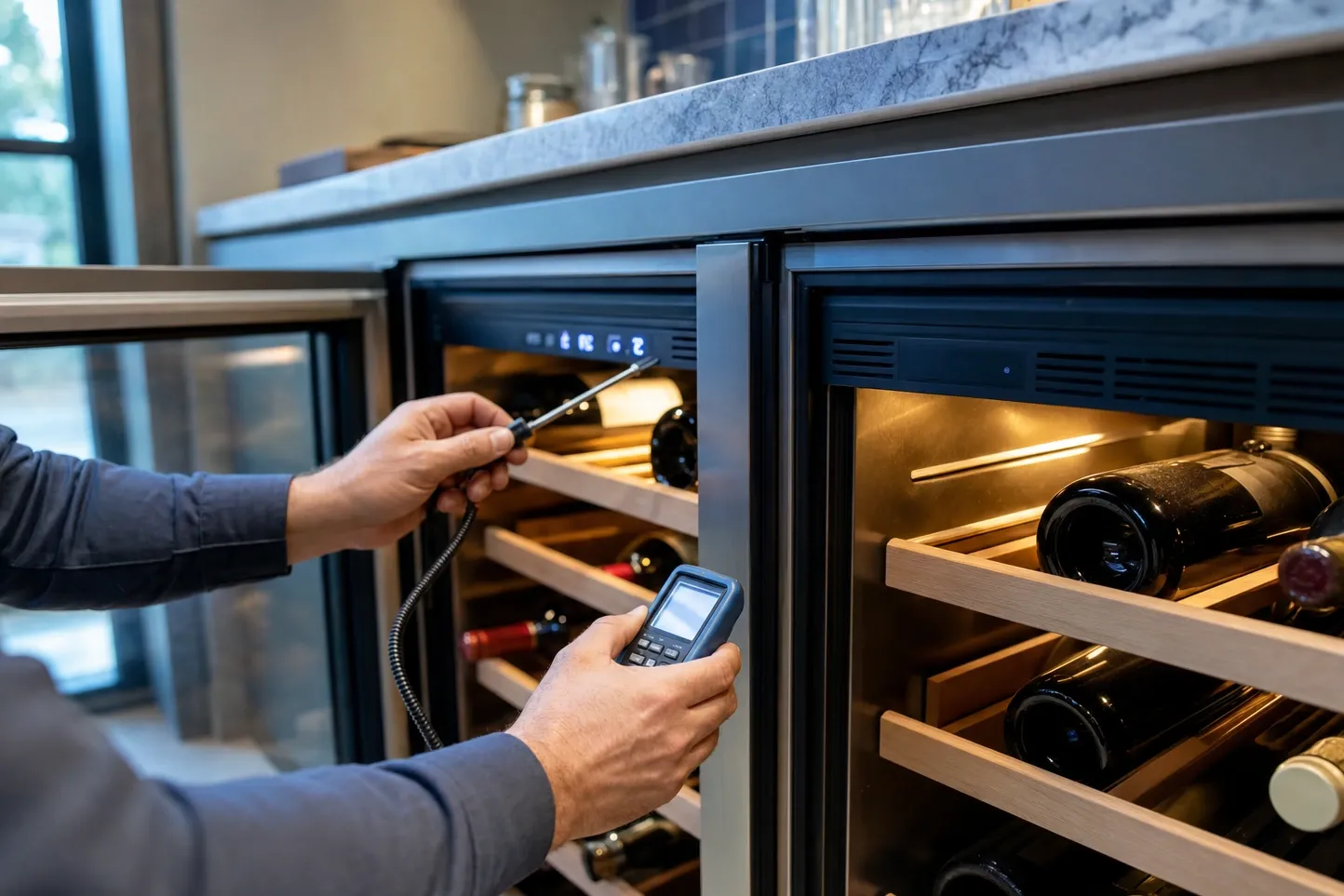
Cabinets, columns, drawers and beverage centres — the refrigeration that lives in joinery and gets the least air in the house. Zones are read with a probe on the shelf before anyone names a part, and the band the repair falls in is published rather than quoted on the doorstep.
- Dry air seals harden and stop pulling the door shut
- High, bright light west-facing glass doors work harder than east ones
- Swamp cooler summers a warmer, damper room to reject heat into
- Diagnosis
- $89 flat, off the total on an approved repair
- On site
- Seven days a week, 8 am to 8 pm
- Line
- Picked up 24/7
-
Wine and undercounter first
Wine cabinets and columns, undercounter refrigerators, drawers and beverage centres. Refrigeration only — no cooking equipment, no laundry.
-
Working here since 2014
The same south-east Denver round every week, which is why a cabinet in a basement bar is a familiar job rather than an unusual one.
-
One published band
Every repair lands in a band you can read before you call, and the firm number inside it is agreed with you before any panel comes off.
-
Licensed, bonded, insured
Insured for work in your home and on your joinery, EPA Section 608 for anything that opens the sealed system, licence number handed over on request.
The local part
What Denver does to a wine cabinet
Three things about this city reach inside a wine cabinet, and none of them is a fault on its own. Each one is the first chapter of the handbook.
-
01
The air takes the seal first
Denver spends most of the year drier than a wine cabinet was designed for, and a door gasket is the part that notices. It stiffens, it stops pulling the door shut on its own, and the rack nearest the door starts reading a degree or two above the rest. Nobody sees a fault; they see a cabinet that runs longer than it used to.
-
02
Cottonwood finds the condenser
From late May the seed gets into everything at floor level, and an undercounter cabinet breathes through a grille down at the kickplate. Sub-Zero asks for a soft brush and a vacuum down there once or twice a year; in a Denver bungalow with a basement bar, once is rarely enough.
-
03
Evaporative cooling changes the room
A swamp cooler works by putting moisture into the house, which is the one thing the rest of the year does not do. The cabinet is suddenly rejecting heat into a warmer, damper room, and the manufacturer is blunt about the consequence: a higher ambient temperature makes the compressor run longer.
Published bands
Five bands, read for a wine cabinet
Once the readings are in, the work lands in one of these five. You are told which band it is and the firm number inside it before a panel comes off. The sixth band in the network's list is for ice equipment and is not priced here.
One flat $89 pays for somebody to arrive and read the cabinet properly; approve the repair and that $89 leaves the bill again.
On a cabinet of bottles Parts and labour, fitted
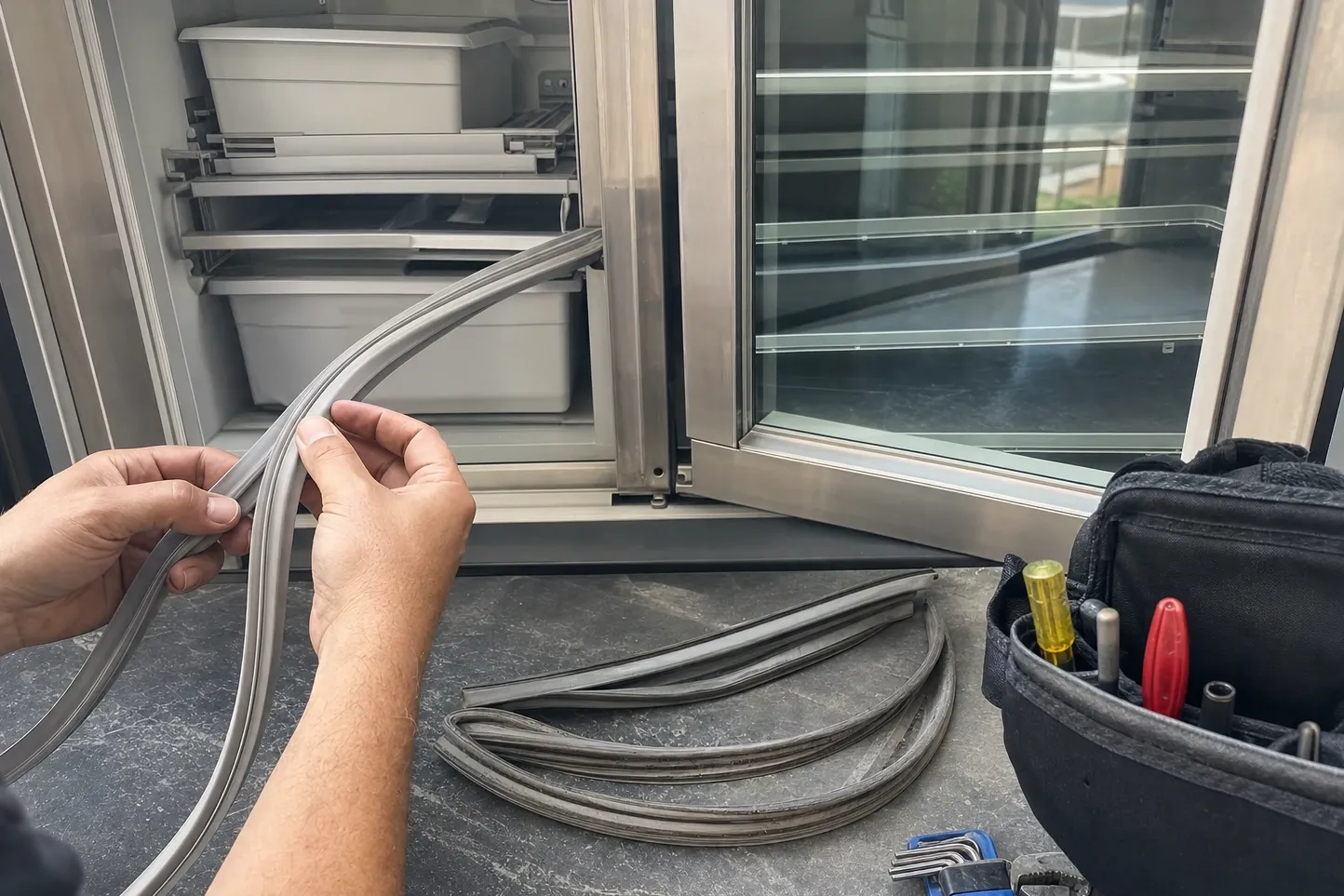
- Door seal The seal round a glass door, replaced with the door off and the frame checked for square.
- $300–$680
- Zone sensor The band a zone thermistor falls in — the part that decides what the panel believes the cabinet is doing.
- $280–$680
- Fan motor Either fan: the one behind the grille that rejects heat, or the one inside that moves air past the bottles.
- $330–$720
- Control board The board behind the lower panel, replaced when metering has ruled the sensors and the fans out.
- $450–$930
- Sealed system Anything that means opening the refrigerant circuit, recovered and recharged under gauges.
- $1,450–$3,030
Ranges, not starting prices. Where a job has no band at all — a rack, a hinge, a plinth cut back for airflow — it is quoted after the diagnosis rather than guessed at over the phone.
A zone reading right and sitting wrong?
On site seven days a week, 8 am to 8 pm across the Denver round. Line picked up 24/7. The diagnosis is $89 and it comes off an approved repair.
Written to be read
A handbook, and three local write-ups
The Denver Wine Cabinet Handbook Seven parts
What to do between visits, in the order the year happens: the seal in winter, the condenser before the cottonwood, the racks when the swamp cooler goes on.
- 01 Dry air and the door gasket: keeping the seal soft
- 02 Cleaning the condenser behind the toe-kick grille
- 03 Swamp cooler season: a June-to-September routine
- 04 Glass doors, west windows and high-altitude sun
- 05 Vibration, levelling and sediment
- 06 Loading the racks without blocking airflow
- 07 Shutting down or leaving a unit for weeks
Denver Conditions 4 write-ups
Longer pieces about faults that behave differently here than they do at sea level, written from calls on this round.
- How to Clean a Sub-Zero Ice Maker, Model by Model To clean a Sub-Zero ice maker, empty the bin and run the CLEAN cycle with descaler and then sanitizer on undercounter models, or wash the bin by hand on full-size units. Here are the steps, amounts and intervals for Denver kitchens.
- Your Swamp Cooler Is Why the Sub-Zero Is Sweating: Summer Condensation and Gasket Mould in Park Hill If your Sub-Zero starts beading along the door frame in June and stops in September, suspect the evaporative cooler rather than the sealed system. Swamp coolers raise indoor humidity by design and pull unfiltered outside air through the house — here is how that reads on a built-in.
- Frost Around a Sub-Zero Freezer Drawer Through a Denver Winter Where the frost sits tells you which fault you have. A rim of ice around the opening is a sealing problem; a sheet on the back wall is the defrost circuit. How to tell them apart in a dry Denver house before you book anyone.
- Sub-Zero Running Constantly and Still Drifting Warm in Denver A built-in that never rests but never gets cold is almost always rejecting heat badly, not making cold badly. What that means in a Denver kitchen, and how to tell a lint-packed condenser from a real sealed-system fault.
Reviews
What Denver owners said afterwards
Built-in Sub-Zero calls, written up by the people who booked them.
5.0/ 5563 reviews
Our bungalow kitchen off South Pearl is tight, and the built-in sat at fifty degrees while the freezer held fine. Evaporator fan motor, replaced from the van. He mapped the temperatures before and after.
Marisol V.Platt Park
Our clear ice turned white and hollow, then production dropped away. A pinched supply line behind the cabinet, plus a filter well past due. Both sorted, though he arrived late in the window.
Bridget H.Platt Park
Fifties ranch, kitchen opened up years ago, and the built-in kept warming overnight then recovering by morning. He tracked it to a door switch leaving the interior light burning. Small part, big difference.
Mabel A.University Hills
Where we work
One round, south-east of the centre
Keeping the round tight is the whole reason a call in the morning can be seen the same week. Each place has its own page with the housing stock and the kind of installation a wine cabinet ends up in there.
- Platt Park 80210 Brick bungalows and Denver Squares off South Pearl, built-ins fitted into remodelled galley kitchens.
- Park Hill 80207 Wide blocks of 1920s Tudors and brick two-storeys, often with paired refrigerator and freezer columns.
- University Hills 80222 Post-war ranches near Colorado Boulevard, kitchens opened up in remodels, undercounter units in basement bars.
- Cheesman Park 80218 Pre-war apartment buildings and divided mansions where integrated columns fit narrow kitchens.
- University Park Brick bungalows and Denver Squares on the shaded streets round the university, most of them with a finished basement and a bar built into it.
- Aurora Newer construction on the eastern edge of the round, where the wine cabinet is usually part of an island the kitchen was designed around.
- Boulder Older brick near the centre, newer houses on the slope, and wine cabinets on lower floors that are cool before the appliance does anything.
The full list
Wine first, and the three that come with it
Wine storage and undercounter work is what this shop is for. The other three are the machines fitted beside them in the same run of joinery, and they get repaired on the same visit rather than on a second one.
-

Wine Cooler Repair
Zone drift, circulation and sealed-system work on Sub-Zero wine storage: undercounter cabinets, integrated columns and dual-zone units built into joinery with almost no clearance.
- One zone reading right on the display and sitting degrees off inside
- Top rack warm while the bottom of the cabinet holds its setting
- The temperature alarm going off overnight and clearing by morning
-

Refrigerator Repair
Undercounter refrigerators, refrigerator drawers and beverage centres, and the full-height built-ins they are fitted beside.
- An undercounter cabinet drifting warm while the column beside it holds
- A drawer front no longer pulling flush against its seal
- Water standing under a wet-bar unit after a warm afternoon
-
Freezer Repair
Frost, temperature drift and defrost faults on Sub-Zero freezer columns and freezer drawers.
- Sheet frost across the panel at the back of the compartment
- A drawer that no longer shuts flush, with frost around the opening
-

Ice Maker Repair
Fill valves, harvest faults and bin sensors on built-in and undercounter Sub-Zero ice makers.
- Production down to a handful of cubes a day, or stopped altogether
- Cubes coming out hollow, cloudy or welded into one block
Questions
Asked on the phone, most weeks
If the answer you need is not here, the line is answered 24/7 — (720) 790-9436.
A zone reads 55 on the display but the bottles feel warmer. What is wrong?
Almost always the thermistor for that zone, or the fan that moves air past it. The display repeats what the sensor tells it, so a sensor reading three or four degrees low will hold a whole zone warm and never complain. An independent probe on the shelf settles it in a few minutes.
Why does the top of the cabinet sit warmer than the bottom?
Warm air collects at the top of any cabinet, and a wine unit only beats that by circulating. When the interior fan slows or the outlet grille at the back of the compartment is packed with bottles, the top rack drifts first. It is a circulation fault far more often than a cooling fault.
Does the dry air in Denver really matter to a wine cabinet?
It does, and the door seal is where it shows. A gasket that has hardened stops pulling the door shut by itself, so the cabinet runs longer to hold its setting and the rack nearest the door drifts. Sub-Zero asks you to check the seal for rips and tears; in this air it is worth checking the closing force too.
Is an undercounter unit in a basement bar a different job?
Mostly it is an access job. The machine compartment sits behind a toe-kick grille a few inches off a cold floor, in a run of cabinetry built after the unit went in. Getting to the condenser and the fan is the slow part; the repair itself is usually the same handful of parts.
What does the visit cost, and when do I hear the repair price?
The visit and the reading cost $89, flat, and that $89 leaves the bill again as soon as you say yes to the repair. What the repair itself costs is a single figure out of a published band, settled with you before a panel is lifted or a part ordered. Nothing here is charged by the hour.
Can a wine cabinet from the early two-thousands still be worth repairing?
Usually, yes. The insulation, the cabinet and the racking outlast the electronics by a long way, and thermistors, fans, heaters, gaskets and control boards are all serviceable parts. Where a sealed-system repair genuinely stops making sense on a particular cabinet, you are told that rather than quoted for it.

How we operate
The terms, in plain rows
Nothing on this page is a badge. It is the set of things we can be held to on a Denver call, written where you can read them before you book.
- Refrigerant work
- EPA Section 608 handling for sealed-system repairs and recovery
- Insurance
- Insured for work carried out inside your home and on your cabinetry
- Parts
- Factory-approved replacements — thermistors, fans, heaters, gaskets, control boards
- Workmanship
- Written warranty on the parts fitted and on the labour to fit them
- The visit
- $89 flat for the trip and the diagnosis, taken off the total on an approved repair
- Equipment
- Built-in and integrated Sub-Zero refrigeration, wine storage and undercounter units
Two ways to book and neither of them is a form: the telephone, or the diary on the booking page. How a call runs.