The Denver Wine Cabinet Handbook · Part 2 of 7
Cleaning the condenser behind the toe-kick grille
The condenser is the radiator of a wine cabinet: a grid of thin aluminium fins down at floor level, handing the heat pulled out of the bottles back to the room. Choke it with dust and nothing announces itself. The cabinet simply works harder, the top rack starts drifting, and a year later somebody rings Denver Sub-Zero Repair Pros about a compressor that was never the thing at fault.
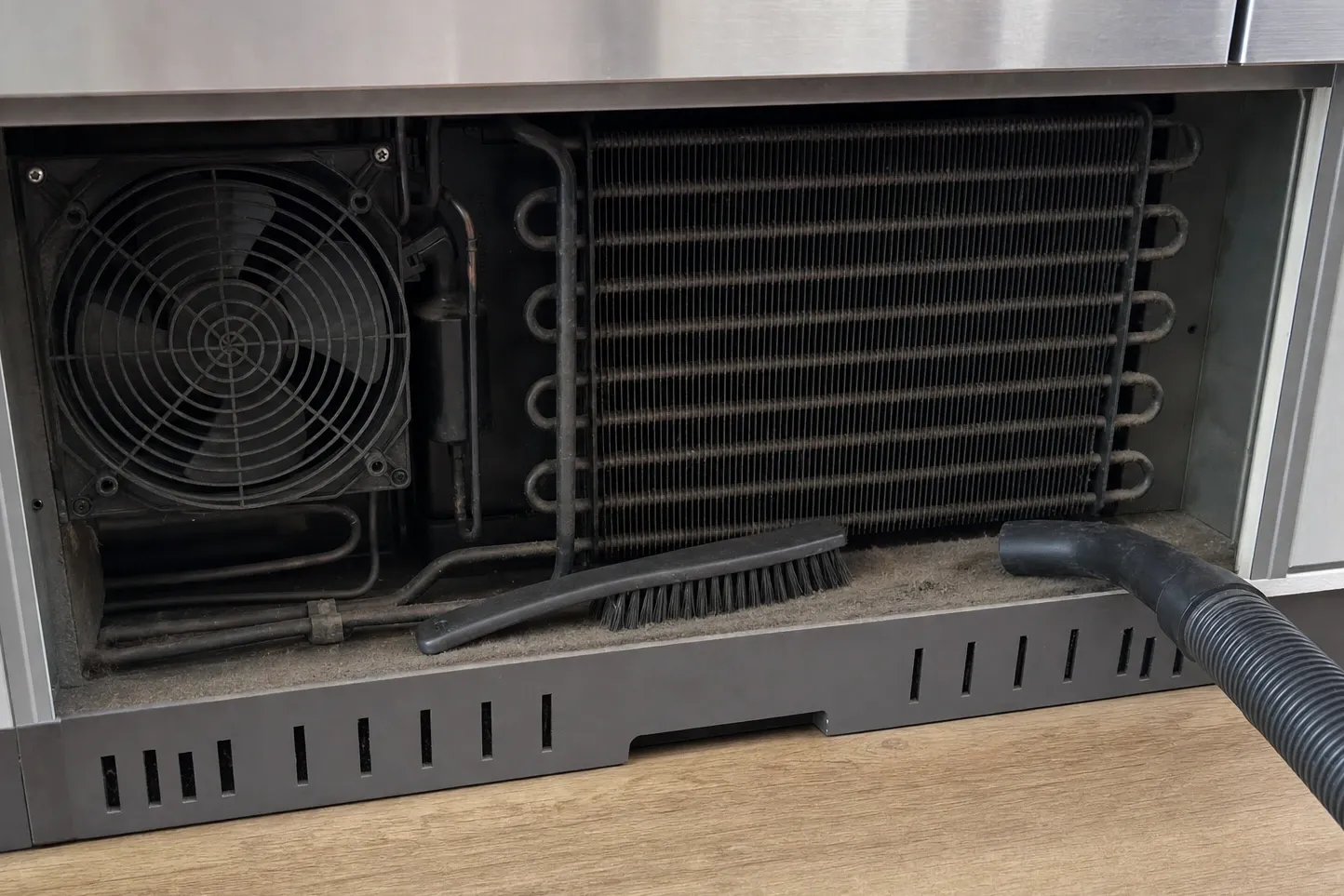
Where it lives, and how it comes off
A wine cabinet breathes at floor level. On a full-height unit the condenser sits at the bottom behind the kickplate; on one of the undercounter wine models it is behind a flip-up grille instead, which releases when you pull out on its bottom edge and rotate it upward. On the current generation the kickplate comes away once its two mounting screws are out.
Two things happen before any of that. Switch the unit off at the control panel, and put gloves on. Sub-Zero prints both as a caution, and the gloves are not fussiness — condenser fins are thin aluminium with edges that will open a knuckle.
Brush, vacuum, and only one direction
A soft bristle brush and a vacuum are the entire toolkit. Work the dust and lint out of the fins with the brush and lift it away with the nozzle, travelling the way the fins run rather than across them. The instruction is in the guide for a mechanical reason: a nozzle dragged sideways folds fins over, the manufacturer’s advice is not to bend them at all, and a folded fin blocks the air it was shaped to pass.
The aerosols and degreasers sold for coil cleaning can stay in the cupboard: Sub-Zero’s published answer says they are unnecessary on its condensers and not recommended.
How often, in a house that runs on open windows
Two intervals are in circulation and both are real, because they belong to different generations of the same appliance. The older wine storage guide asks for a clean every three to six months. The current Designer guide, and Sub-Zero’s own support answer, say every six to twelve, and more often in a household with pets.
Denver argues for the shorter end of whichever applies. A house cooled by drawing outside air through open windows spends the summer pulling seed fluff, pollen and street dust across a grille at floor level — the one part of the cabinet that has to stay clear. A basement bar collects more again, because dust in a cool room settles rather than rising.
The routine
- Before the windows start opening Take the kickplate or grille off and look, ahead of the season rather than during it. A condenser that goes into the warm months already grey has no spare capacity for what is coming through those windows.
- A month into the open-window season Brush and vacuum properly, whatever the calendar says. This is the clean that earns the most in a Denver year, and the one most often skipped, because a cabinet losing capacity slowly is still holding its setting.
- Before the heating goes on Second full clean of the year, as the house changes from open and damp to closed and dry.
- Monthly, from the doorway Crouch and look through the grille without taking anything apart. Grey felt across the fins means the next clean has come early; clean metal means you can leave it until the next date on this list.
- Any time SERVICE flashes The panel flashes it when a temperature problem has been detected or the condenser wants cleaning. Clean the fins, switch the unit off at the control panel and on again, and watch whether the indicator clears.
Stop here Fins that are genuinely clean, a grille with nothing across it, and a cabinet that still runs long or sits warm at the top: at that point the condenser has been ruled out, and what is left is a fan, a seal or a reading, none of which a brush can reach. Denver Sub-Zero Repair Pros takes it from there — call (720) 790-9436, or reserve a slot.
Two follow-ups
What happens if the condenser is never cleaned at all?
Sub-Zero puts this in a caution rather than a footnote: a condenser left dirty can cost the cabinet its temperature, and after that comes mechanical failure or damage. The sequence is slow enough to miss. The cabinet runs longer, the upper zone stops holding, the fan pushes against resistance for months, and the compressor is the last part to complain.
Does the SERVICE indicator mean something has already broken?
Not by itself. The panel flashes it either when a temperature problem has been detected or when the condenser needs cleaning, which puts the brush before the telephone. Clean the fins, switch the unit off at the control panel and back on, and if the indicator keeps flashing afterwards, ring Denver Sub-Zero Repair Pros on (720) 790-9436.